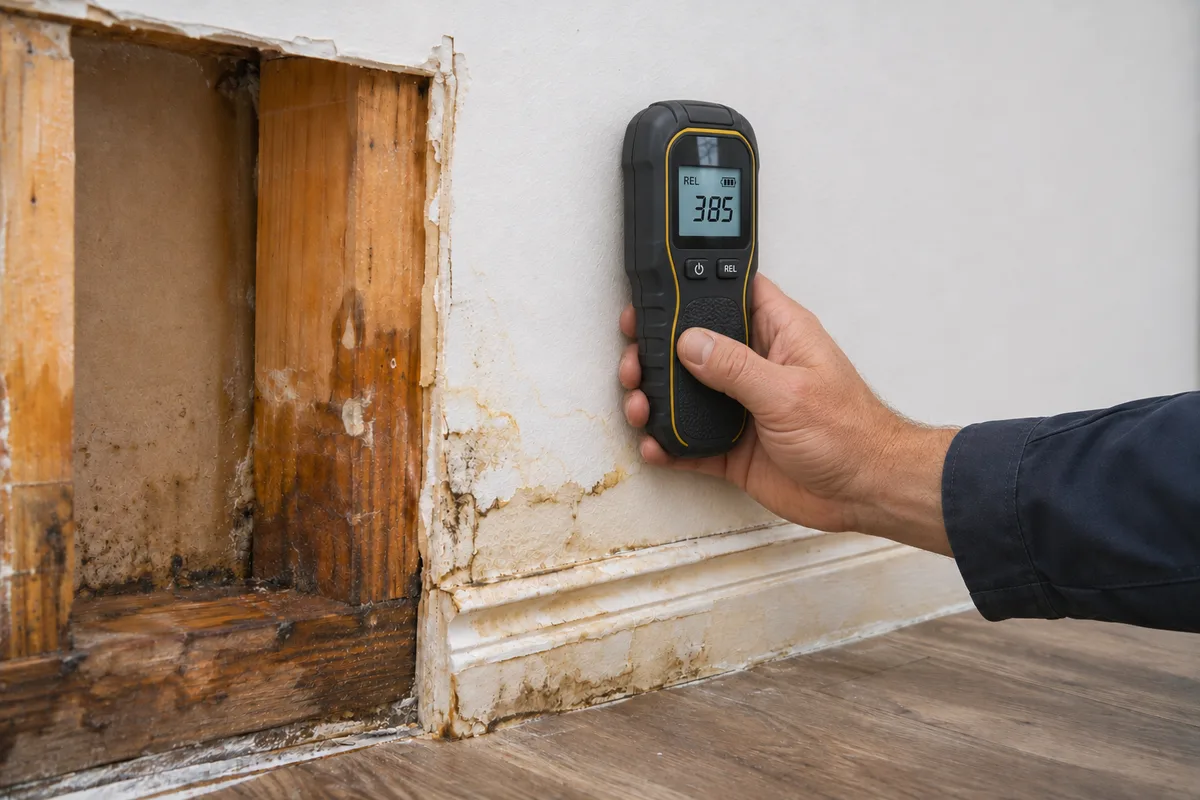
Begin with the incident history.
When was the water first noticed? Was it a single overflow, repeated rain entry or a leak with an unknown start time? Has the source been investigated? These details help put observations into context.
Describe the rooms and material layers, including carpet, underlay, skirtings, wall linings, framing and any ceiling below. Share earlier contractor findings if available, while keeping observations separate from assumptions.
Understand what a reading can tell you.
Moisture checking needs a method suited to the material and an explanation of the result. A number on a meter should be interpreted in context, including the construction, access and comparison with suitable unaffected material where appropriate.
Ask what can be checked, what remains concealed and whether further access or specialist assessment is needed. The assessment should make its limitations clear rather than suggest that a quick surface check answers every question.
Connect the findings to the work.
The practical outcome might be a drying scope, a material-removal decision, further source investigation or a referral to another qualified trade. Ask how those recommendations follow from the affected materials and observed conditions.
For an ongoing drying job, discuss which locations will be checked again and how progress will inform equipment changes or the next repair stage. A fixed number of equipment days is not the same as evidence that all relevant materials are ready.
Know which report you need.
A property manager may need restoration observations, while a building contractor may be asking for a defect investigation, engineering opinion or an independent clearance. These are different scopes and may involve different professionals.
Explain who requested the assessment and what decision they are trying to make. Confirm the inspection scope, records available, access and charges before agreeing to attendance.
Frequently asked questions
Does a thermal camera prove a wall is wet?
A thermal image records temperature patterns. It can help guide investigation, but interpretation and appropriate moisture checks are needed before conclusions about a material are made.
Can photos replace an on-site moisture assessment?
Photos can explain the visible problem. They do not establish concealed moisture, material condition or electrical safety.
Can the assessment identify who is responsible for a leak?
A restoration assessment should not be assumed to determine liability or every building defect. Explain the question in advance so the appropriate professional scope can be discussed.
Find local information.
Explore moisture assessment enquiries by area. Confirm the available service and attendance directly with the team.